Customer Relationship Management (CRM) has become an essential component of modern business strategy, enabling organizations to build stronger relationships with customers, improve operational efficiency, and increase profitability. As customer expectations continue to evolve, businesses require CRM systems that not only manage customer information but also support various organizational functions such as sales, marketing, customer service, and strategic decision-making. To address these diverse business needs, CRM has developed into several distinct types, each designed to fulfill specific organizational objectives. Understanding the different types of Customer Relationship Management allows businesses to choose the most appropriate CRM approach that aligns with their goals and operational requirements.
The three primary types of Customer Relationship Management are Operational CRM, Analytical CRM, and Collaborative CRM. In addition, many organizations also incorporate Strategic CRM as a broader customer-focused philosophy that integrates all CRM activities. Each type plays a unique role in improving customer relationships while supporting overall business performance.
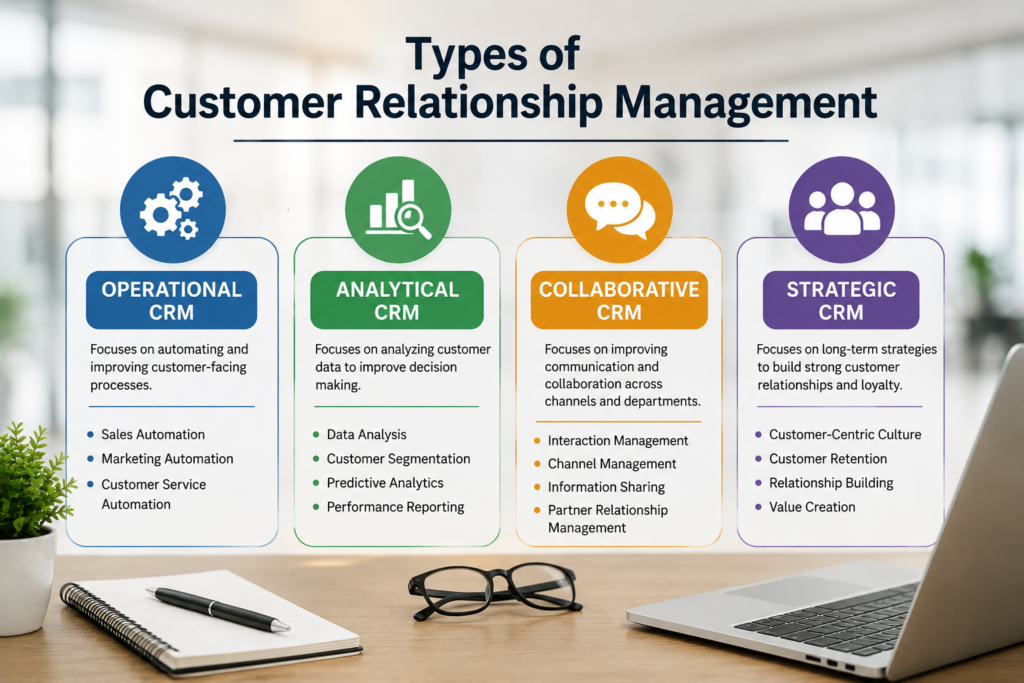
Operational CRM is the most widely implemented type of CRM in modern organizations. Its primary purpose is to automate and improve customer-facing business processes, including sales, marketing, and customer service. Operational CRM helps businesses streamline routine activities, reduce manual workloads, and ensure that customer interactions are handled efficiently. By automating repetitive tasks, employees can devote more time to building relationships with customers rather than managing administrative responsibilities.
One of the key components of Operational CRM is Sales Force Automation (SFA). Sales Force Automation enables sales representatives to manage customer information, track leads, monitor sales opportunities, schedule follow-up activities, and generate sales forecasts. Instead of relying on spreadsheets or paper-based records, sales teams can access real-time customer data from a centralized database. This improves productivity, enhances communication among team members, and increases the likelihood of successful sales conversions.
Another important element of Operational CRM is Marketing Automation. Marketing Automation allows organizations to design, execute, and monitor marketing campaigns more efficiently. Businesses can automatically send promotional emails, manage social media campaigns, segment customers according to specific characteristics, and measure campaign performance using real-time analytics. Automated marketing not only saves time but also enables organizations to deliver highly personalized content that resonates with individual customer preferences.
Customer Service Automation is also a critical function of Operational CRM. Customer support representatives use CRM systems to manage service requests, record customer complaints, track issue resolution, and provide personalized assistance. Because customer information is stored in a centralized database, support teams can quickly review previous interactions and resolve problems more efficiently. This improves customer satisfaction while reducing service response times and operational costs.
The second major type of CRM is Analytical CRM. Unlike Operational CRM, which focuses primarily on automating customer interactions, Analytical CRM emphasizes collecting, analyzing, and interpreting customer data to support business decision-making. Modern organizations generate enormous amounts of customer information through online purchases, website visits, social media interactions, customer surveys, and support requests. Analytical CRM transforms this raw data into meaningful insights that help organizations better understand customer behavior and market trends.
One of the primary benefits of Analytical CRM is customer segmentation. Businesses can categorize customers based on demographics, purchasing history, geographic location, spending behavior, or personal interests. These customer segments enable organizations to develop targeted marketing campaigns that address the unique needs of different customer groups. Personalized marketing improves customer engagement while increasing the effectiveness of promotional activities.
Analytical CRM also supports predictive analytics, allowing businesses to anticipate future customer behavior. By analyzing historical purchasing patterns and customer interactions, organizations can forecast future sales, identify customers who may stop purchasing, and predict product demand. These insights enable businesses to develop proactive strategies that improve customer retention and maximize revenue opportunities.
Another valuable feature of Analytical CRM is performance reporting. Managers can generate dashboards and reports that measure key performance indicators such as sales growth, customer acquisition rates, customer lifetime value, campaign effectiveness, and service quality. These reports provide decision-makers with accurate information that supports strategic planning and continuous business improvement.
The third major category is Collaborative CRM. This type of CRM focuses on improving communication, coordination, and information sharing among different departments within an organization as well as external business partners. Collaborative CRM recognizes that delivering exceptional customer experiences requires seamless cooperation between sales, marketing, customer support, finance, logistics, and other organizational units.
Collaborative CRM enables employees from different departments to access the same customer information through a centralized database. For example, if a customer contacts customer service regarding a previous purchase, the support representative can immediately review sales records, marketing communications, and prior service interactions. This comprehensive customer view allows employees to provide faster, more consistent, and more personalized service.
Communication management is another important aspect of Collaborative CRM. Modern customers interact with businesses through multiple communication channels, including email, telephone, websites, mobile applications, live chat, and social media platforms. Collaborative CRM integrates these communication channels into a single customer profile, ensuring that every interaction is recorded and accessible across departments. This omnichannel approach provides customers with consistent experiences regardless of how they choose to communicate with the organization.
Supplier and partner collaboration can also be enhanced through Collaborative CRM. Many organizations work closely with distributors, suppliers, logistics providers, and business partners to deliver products and services. CRM systems facilitate information sharing among these stakeholders, improving coordination, reducing delays, and enhancing customer satisfaction through more efficient service delivery.
In addition to the three primary CRM categories, many experts recognize Strategic CRM as an overarching business philosophy. Strategic CRM focuses on creating a customer-centric organizational culture in which every business decision prioritizes customer value and long-term relationship building. Rather than viewing CRM solely as software, Strategic CRM emphasizes aligning organizational goals, leadership, employee behavior, and business processes around customer satisfaction.
Strategic CRM encourages businesses to understand customer expectations, continuously improve service quality, and develop personalized experiences that strengthen customer loyalty. Organizations implementing Strategic CRM often invest heavily in employee training, customer feedback programs, loyalty initiatives, and innovation aimed at enhancing customer experiences. This long-term perspective helps businesses establish sustainable competitive advantages by building lasting customer relationships.
Modern CRM platforms often combine features from Operational, Analytical, Collaborative, and Strategic CRM into integrated software solutions. Cloud-based CRM systems provide organizations with centralized access to customer information while supporting automation, analytics, communication, and collaboration within a single platform. This integrated approach eliminates information silos and enables businesses to respond more quickly to changing customer needs.
The emergence of artificial intelligence (AI) and machine learning has further expanded the capabilities of all CRM types. AI-powered CRM systems can automatically recommend products, predict customer behavior, analyze customer sentiment, and automate customer support through intelligent chatbots. Predictive analytics enables organizations to identify sales opportunities and customer retention risks before they occur. These advanced technologies improve decision-making while reducing operational costs and increasing efficiency.
Selecting the appropriate type of CRM depends on an organization’s size, industry, objectives, and available resources. Small businesses may initially focus on Operational CRM to automate daily activities and improve efficiency. Larger organizations with extensive customer databases often invest in Analytical CRM to gain deeper business insights. Companies operating across multiple departments and communication channels benefit significantly from Collaborative CRM, while organizations committed to long-term customer loyalty adopt Strategic CRM as a core business philosophy.
Despite the advantages of CRM, successful implementation requires careful planning, employee training, and continuous evaluation. Organizations must maintain accurate customer data, encourage employee adoption, and regularly update CRM processes to reflect changing business requirements. Strong leadership support and a customer-focused organizational culture are essential for maximizing the benefits of CRM systems.
In conclusion, Customer Relationship Management consists of several distinct yet interconnected types, each serving different organizational purposes. Operational CRM improves business efficiency by automating customer-facing processes, Analytical CRM transforms customer data into strategic insights, Collaborative CRM enhances communication and coordination across departments, and Strategic CRM establishes a customer-centered organizational culture. Together, these CRM types enable businesses to deliver superior customer experiences, strengthen customer loyalty, improve operational performance, and achieve sustainable competitive advantages in today’s dynamic business environment. As technology continues to evolve, organizations that effectively integrate multiple CRM approaches will be better positioned to meet customer expectations and drive long-term business success.