Customer Relationship Management (CRM) has evolved significantly over the past few decades, transforming from a simple contact management system into a sophisticated business strategy supported by advanced technologies. As customer expectations continue to rise and digital transformation accelerates across industries, CRM systems are becoming more intelligent, personalized, and data-driven. Businesses increasingly recognize that maintaining strong customer relationships is essential for long-term success, and future CRM developments will play a critical role in helping organizations achieve this objective. Understanding the future trends in Customer Relationship Management enables businesses to prepare for emerging opportunities, improve customer experiences, and maintain a competitive advantage in a rapidly changing marketplace.
One of the most influential trends shaping the future of CRM is the integration of Artificial Intelligence (AI). AI-powered CRM systems can analyze vast amounts of customer data, identify patterns, and provide actionable insights that support decision-making. AI technologies enable businesses to understand customer behavior more accurately and predict future needs. For example, AI can recommend products based on previous purchases, forecast customer churn, and identify sales opportunities. These capabilities allow organizations to deliver highly personalized experiences while improving operational efficiency.
Machine learning, a subset of artificial intelligence, is also becoming an essential component of modern CRM systems. Machine learning algorithms continuously learn from customer interactions and improve their predictions over time. As CRM platforms collect more data, machine learning can enhance customer segmentation, lead scoring, and sales forecasting. Businesses can use these insights to develop targeted marketing campaigns, prioritize high-value prospects, and improve customer retention strategies. The growing adoption of machine learning will make CRM systems more proactive and capable of anticipating customer needs before they arise.
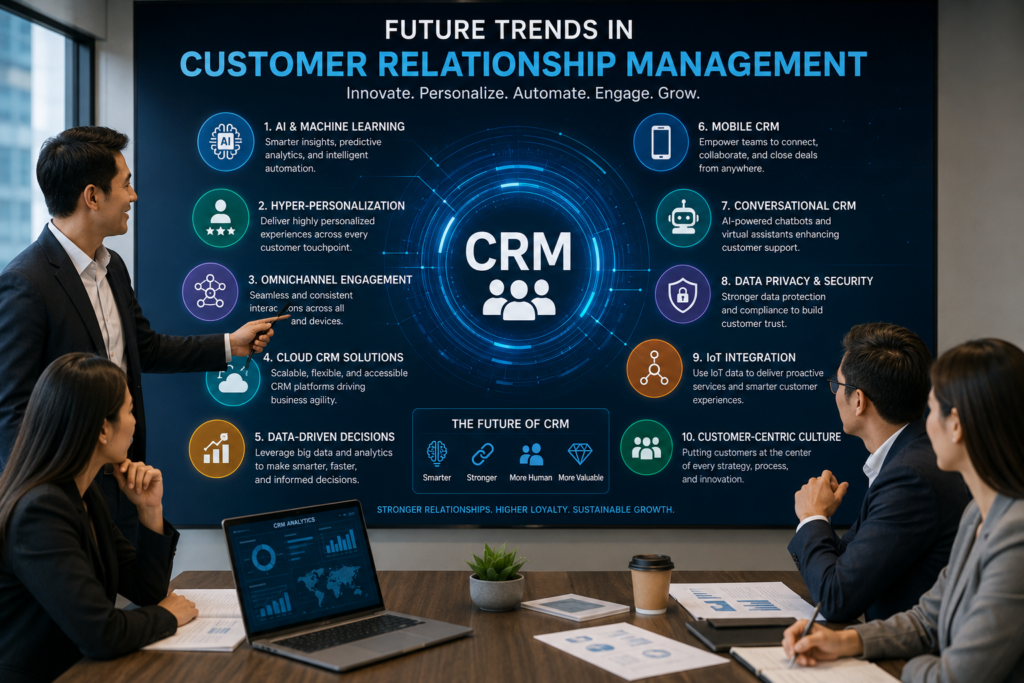
Another major trend is hyper-personalization. Customers increasingly expect businesses to provide experiences tailored specifically to their preferences, behaviors, and interests. Traditional personalization methods, such as using a customer’s name in an email, are no longer sufficient. Future CRM systems will leverage advanced analytics, AI, and real-time data to deliver highly individualized experiences. Businesses will be able to create personalized product recommendations, customized marketing messages, and unique customer journeys based on detailed customer profiles. Hyper-personalization enhances customer satisfaction and strengthens brand loyalty by making customers feel understood and valued.
The rise of omnichannel customer engagement is another important CRM trend. Modern consumers interact with businesses through multiple channels, including websites, mobile applications, social media platforms, email, live chat, and physical stores. Customers expect seamless experiences regardless of the channel they choose. Future CRM systems will provide unified customer views by integrating data from all communication channels into a single platform. This integration ensures consistent interactions and enables businesses to respond effectively to customer needs across every touchpoint. Omnichannel CRM strategies will become increasingly essential as customer interactions continue to diversify.
Cloud-based CRM solutions are expected to dominate the future CRM landscape. Cloud technology offers businesses greater flexibility, scalability, and accessibility compared to traditional on-premise systems. Employees can access customer information from any location using internet-connected devices, supporting remote work and global collaboration. Cloud-based CRM platforms also reduce infrastructure costs and simplify software updates. As organizations continue to embrace digital transformation, cloud CRM adoption will increase, making advanced customer relationship management tools more accessible to businesses of all sizes.
The growing importance of mobile CRM is another significant trend. Mobile devices have become an integral part of daily life, and businesses increasingly rely on mobile technologies to engage customers and manage operations. Future CRM systems will offer enhanced mobile functionality, enabling employees to access customer data, update records, manage sales opportunities, and communicate with clients directly from smartphones and tablets. Mobile CRM improves productivity and responsiveness, particularly for sales teams and customer service representatives who frequently work outside traditional office environments.
Predictive analytics is also expected to play a central role in the future of CRM. Predictive analytics uses historical and real-time data to forecast future customer behaviors and outcomes. CRM systems equipped with predictive capabilities can identify customers who are likely to make purchases, detect potential churn risks, and anticipate service needs. These insights allow businesses to take proactive actions that improve customer satisfaction and increase revenue opportunities. As data collection and analytical capabilities continue to advance, predictive CRM solutions will become increasingly accurate and valuable.
Customer data platforms (CDPs) are emerging as a complementary technology to CRM systems. While traditional CRM platforms focus on managing customer interactions, CDPs specialize in collecting and unifying customer data from multiple sources. Future CRM solutions are likely to integrate closely with CDPs to create comprehensive customer profiles that provide deeper insights into customer behavior. This integration enables businesses to deliver more relevant experiences, improve targeting accuracy, and strengthen customer relationships through better understanding of individual preferences.
Automation will continue to reshape CRM practices in the coming years. Businesses are increasingly using automation to streamline repetitive tasks such as data entry, lead nurturing, appointment scheduling, and customer follow-ups. Future CRM systems will feature more advanced automation capabilities powered by AI and machine learning. Intelligent automation will reduce administrative burdens, improve efficiency, and ensure consistent customer engagement. Employees will have more time to focus on strategic activities such as relationship building and problem-solving, enhancing overall business performance.
Another emerging trend is the use of conversational CRM technologies. Chatbots, virtual assistants, and AI-powered messaging platforms are becoming increasingly popular for customer communication. These technologies provide instant responses to customer inquiries and support around the clock. Future CRM systems will integrate more sophisticated conversational tools capable of understanding natural language, recognizing customer emotions, and delivering highly personalized interactions. Conversational CRM improves accessibility and convenience while enhancing the overall customer experience.
Data privacy and security will remain critical concerns as CRM systems continue to evolve. Customers are becoming more aware of how businesses collect, store, and use their personal information. Governments worldwide are implementing stricter regulations regarding data protection and privacy. Future CRM platforms will prioritize secure data management, compliance with privacy laws, and transparent data practices. Businesses that demonstrate strong commitment to protecting customer information will build greater trust and strengthen customer relationships.
Social CRM is another trend gaining momentum. Social media platforms have become important channels for customer engagement, feedback, and brand interaction. Future CRM systems will integrate social media data more effectively, enabling businesses to monitor customer sentiment, respond to comments, and identify emerging trends in real time. Social CRM helps organizations understand customer opinions and participate in meaningful conversations that enhance brand reputation and customer loyalty.
The integration of the Internet of Things (IoT) with CRM systems is expected to create new opportunities for customer engagement. IoT devices generate valuable data about customer usage patterns and product performance. Future CRM platforms can utilize this information to provide proactive support, personalized recommendations, and predictive maintenance services. For example, connected devices can automatically notify businesses when customers may require assistance or product upgrades, improving service quality and customer satisfaction.
In conclusion, the future of Customer Relationship Management will be shaped by technological innovation, evolving customer expectations, and increasing demand for personalized experiences. Artificial intelligence, machine learning, hyper-personalization, predictive analytics, cloud computing, automation, and omnichannel engagement will transform how businesses interact with customers. Organizations that embrace these trends and invest in advanced CRM capabilities will be better positioned to strengthen customer relationships, improve operational efficiency, and achieve sustainable growth. As CRM continues to evolve, it will remain a vital strategic tool for organizations seeking to deliver exceptional customer experiences and maintain a competitive advantage in the digital era.